Plain Talk: A Flooded Smoker & Failed Queen (305)
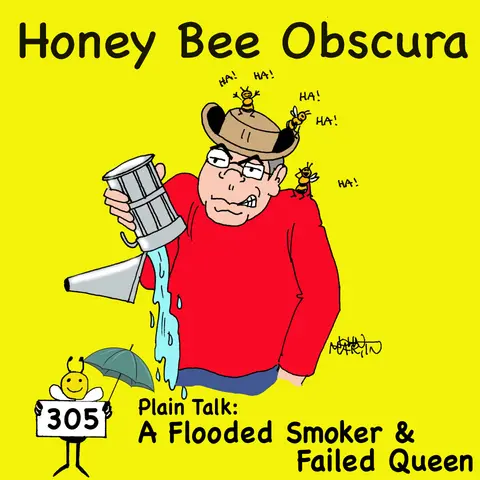
Dr. Jim Tew discovers a flooded smoker and then performs a late-season autopsy on a failed swarm colony. With no clear signs of Varroa collapse or American foulbrood, Jim suspects queen failure and considers whether requeening or combining such a weak colony in September would have been worthwhile. Along the way, he reflects on fall forage, small nucs, winter preparation, and the difficult question every beekeeper eventually faces: when is a struggling colony no longer worth trying to save?

 Apple Podcasts

 YouTube

 Spotify

 Amazon Music

 Overcast

 Castro

 RSS Feed
Key Takeaways
- Queen failure can cause a colony to decline without the dramatic signs associated with disease or a heavy Varroa collapse.
- Scattered drone brood without queen cells can provide clues that a queen or laying situation has failed.
- Combining a weak colony isn't automatically the best answer if it adds problems rather than useful population to a stronger colony.
A beautiful autumn day in the bee yard begins with an unexpected discovery for Dr. Jim Tew: his normally reliable smoker-storage system has failed spectacularly. A windblown lid and several rainstorms have left his smoker half submerged, his hive tools soaked, and his carefully organized system in need of drying out.
But that isn't the only surprise waiting for Jim.
A swarm colony he had collected earlier in the season has died, so Jim opens the hive for a late-season autopsy. Wax moths have already moved in, but the comb tells a larger story. Jim finds scattered drone brood, no queen cells, and no obvious signs of American foulbrood or a Varroa collapse. His conclusion: the colony likely declined after its queen failed.
That leads to a harder question: even if Jim had caught the problem several weeks earlier, would requeening a small colony in September have made sense?
Jim considers the cost of a queen, the time required for introduction, dwindling fall forage, and the risks of combining a weak colony with a stronger one. Then he turns his attention to another small nuc that may still deserve some extra care before winter.
It's a thoughtful walk through the realities of fall beekeeping—where sometimes the most difficult management decision is deciding when not to intervene.
______________________

Thanks to Betterbee for sponsoring today's episode. Betterbee's mission is to support every beekeeper with excellent customer service, continued education and quality equipment. From their colorful and informative catalog to their support of beekeeper educational activities, including this podcast series, Betterbee truly is Beekeepers Serving Beekeepers. See for yourself at www.betterbee.com

We'd like to thank Vita Bee Health for supporting the podcast. Vita provides proven tools for controlling Varroa—from Apistan and Apiguard to the new VarroxSan extended-release oxalic acid strips—helping beekeepers keep stronger, healthier colonies.

Thanks to Bee Culture, the Magazine of American Beekeeping, for their support of Honey Bee Obscura. Available in print and digital at www.beeculture.com
______________________
Honey Bee Obscura is brought to you by Growing Planet Media, LLC, the home of Beekeeping Today Podcast.
Music: Heart & Soul by Gyom, All We Know by Midway Music; Christmas Avenue by Immersive Music; original guitar music by Jeffrey Ott
Cartoons by: John Martin (Beezwax Comics)
Copyright © 2026 by Growing Planet Media, LLC

Frequently Asked Questions
What did Jim think caused the swarm colony to fail?
He suspected queen failure. The colony contained scattered drone brood and no queen cells, while he saw no obvious evidence of American foulbrood or a Varroa-related collapse.
Why didn't Jim simply requeen the colony?
By the time he estimates the problem developed, it was already mid-September. Purchasing, retrieving, introducing, and establishing another queen would have taken time and money very late in the season.
Would combining the weak colony with another colony have solved the problem?
Jim isn't convinced. He notes that combining a rundown colony can sometimes leave the stronger colony with additional comb and population to support without providing much real benefit.
305 - Plain Talk: A Flooded Smoker & Failed Queen
Jim Tew
Well beekeepers, it is an absolutely spectacular day. The colors are just starting to turn And I just said in a beekeeping article that I'm writing, I'm in a reflective stage of beekeeping. What does that mean?
That means I just like being back here I don't have to really do anything other than just be here and enjoy the beauty of everything. But, alas, I've got a mistake that's happened that's not very pretty at all. I'll tell you about it just as soon as we get started in this segment.
This is I'm Jim Tew and I come to you here about once a week where I try to talk about something to do with plain talk beekeeping.
Introduction
Welcome! To Honey Bee Obscura, brought to you by Growing Planet Media, the producers of the Beekeeping Today podcast. Join Jim Tew, your guide through the complexities, the beauty, the fun, and And the challenges of managing honey bees.
Jim hosts fun and interesting guests who take a deep dive into the intricate world of honey bees. Whether you're a seasoned beekeeper or just getting started, get ready for some plain talk. that'll delve into all things honey bees.
Jim Tew
I don't know when it happened. I haven't been back here in five or six days. I took a trip.
I was gone for about the better part of a week. I don't know when it happened, but I've got a foolproof system that I really like. Years ago, at a surplus equipment sale, I bought three or four really heavy-duty old fashioned can't find them anymore Galvanized cans.
They're about ten gallons, and they have lids that go with them. So I used one of those to hold my smoker fuel and my lighter and some paper for starting the smoker And then the other one I would put my lit smoker in that I had stuffed the entrance to. And I would let it die out in that other can so I didn't have a fire hazard back in my yard.
And then when I would come back in this beautiful plan, I would use one of the heavy lids and I would dump out the previous smoker fuel that had partially burned down. And using that charcoal and that fresh piece of paper, I would restart the smoker and it would start right up, and then I would add fresh shavings to it. I use wood shavings.
And pack it and pack it and add more, puff it, puff it, pack it, and then I could get a smoker going fairly quickly. And it's worked beautifully for 10 or 12 years. But somewhere along the way a strong wind came through and blew the lid off.
And we've had, of course, like everybody else, really good rain showers every now and then. So my smoker was halfway submerged, my two hive tools are wet. I don't know if the striker or the lighter will ever work again.
So I just got a mess because somehow that tight fitting lid blew off That's a screw up. So I've got my smoker drying. I've got the hive tools drying.
I got the can upturned draining. And I hope that in the next couple of warm days That everything will dry out and I can restart my system. I don't know if my smoker's ruined or not.
The bellows was about half underwater. It's not good unless this is a way to wash your smoker. Alright, I wasn't expecting that.
It's just another exciting event in the bee yard. What I came back here for was to do a quick review, an autopsy of a swarm that died looked like about, I don't know, two or three weeks ago. Like I said, I was traveling.
Went down to Tennessee and Alabama and I was gone for a while and I didn't come back here every day. And I was surprised to see that this swarm that I picked up, I don't remember the exact swarm story behind it. Every time I picked up a swarm I told you about it, but I've got two back here.
I don't know which are which. This dead. So let's have a look at it.
It's got a a plastic cover. It's glued down. Got that off.
It's got an inner cover that's glued down to. Must sound like I've got one long pause. So I'm breaking the inner cover loose. It was tied down with some burr comb Oh, they've really propolized this up nicely with all this burr comb.
It's just a swarm. It was a small swarm and I had it in a single deep, but they did a really good job of propalizing everything. So this is going to be a pistol to get a frame out.
This is where I should do the Jim Tew thing. I don't have my little hammer with me, though, and open it from the bottom up and drive a the first frame out from the bottom but let me see if I can pry that out It's slowly snapping out. No, come on out.
And everybody says these are removable frames and these modern beehives we call it But unless you and I go in all the time and keep the propolis scraped down, this is not really a movable framed hive I got a frame out. Nothing's on it. I don't have any protective gear on and I'm right next door to a fairly powerful colony.
I'll probably get lit up. Yeah, here it is. Well I'm officially keeping both the greater and lesser wax moths So the wax moths have made their move on it, taking out pollen.
And listeners, very clearly, they went queenless. And Died from having either a laying worker. It it looks like a laying worker.
It doesn't I don't see queen cells. I got the nice autumn sun coming over my shoulder. And I'm looking on what would be the lower edge of the cones Just to be sure I don't see any flat scales from American foulbrood.
And happily, I don't see that. At one time it was a good colony. It's really doing a great job with these wax moths.
I'm gonna shake them out. I've got yellow jackets coming in to explore all this. You know, I told you before this is a real ecosystem back here in the bee yard.
Here's yet another frame, and now I've got a few bees on it researching it. Nothing is here. Same drill.
All it is is very, very scattered uncapped drones No queen cells. So I'm guessing it was either a drone layer or I'm gonna go with the drone layer. I'm I'm just guessing as I do this basic inspection Because the drones are all the correct size, they're not undersized.
So as is so often the case, I'm going to blame the Queen. The queen lost her goodness. Couldn't perform the job.
And for whatever reasons, the bees didn't replace her They're dead. So I was looking to see if I'd had some kind of varroa collapse to see if my treatment plan wasn't working. There doesn't seem to be a varroa collapse It doesn't appear to be American foulbrood.
It appears that I just had a defective queen that got away from me. What would I have done if I had known? I've talked about this, I've given talks about it, I've got a talk coming up on the subject.
Let's take a break and hear from our sponsor. And I'll quickly go into what I should have done had I been on the job better.
Betterbee
For more than 45 years, Betterbee has proudly supported beekeepers by offering high-quality, innovative products, providing Outstanding customer service, many of our staff are beekeepers themselves, and sharing education to help beekeepers succeed. Based in Greenwich, New York, Betterbee serves beekeepers all across the United States. United States.
Whether you're just getting started or a seasoned pro, Betterbee has the products and experience to help you and your bees succeed. Visit betterbee. com or call 1-800-632-3379.
Better Be, your partners in Betterbeekeeping
Vita Bee Health
We'd like to thank Vita Bee Health for supporting this podcast. Vita provides proven tools for controlling Varroa, Apistan, and Apiguard to the new VarroxSan extended release oxalic acid strips, helping beekeepers keep stronger. healthier colonies.
Jim Tew
Well I guess I'll date this segment by telling you that it's it's about the first week in October now. So three weeks ago would have been mid-September. And I have frequently said that sometimes it's not worth it.
So even if I'd caught this queen three weeks ago, the colony was already in decline. It's already late summer, early fall. Queens, if you can get them, have probably been banked.
Who knows how long. I don't know what that means. Is it good or bad?
Does it matter That the queen was probably produced last spring and then held in in reservoir colonies or nursery colonies until there was a demand to sell them. It would have been kind of pricey. The colony would have gotten the queen late.
It would have been expensive. I have to drive to go get the queen about 40 miles one way. I don't know what $35-40 for the queen.
Come back, go through the introduction process, take about a week, and then all that just in time for what bit of goldenrod they're going to get and wild asters. Question. Would I even have requeened it if I'd found it?
That sounds heartless, doesn't it? But you consider the energy and the money. I can't say it any better than Kim.
He said it in almost every segment when we had Kim. What's your time worth? What's your time worth?
You remember I went over to my friend's house who had that tiny little swarm barely bigger than a softball that she wanted to save and I told her it's going to die and it died. So I think I need to listen to my own lecture here Even if I'd found this colony, I probably would have just combined it. But others have said, far more intelligent in beekeeping than I, you're not doing another colony any favors.
Putting on a weak run-down colony with a lot of drones, you're just giving it more comb. and more drones and more comb to take care of. So it's really not really sure what to do.
with weak colonies, small colonies in the fall. And it sounds like you're you you know you're just letting them die heartlessly. No, it's it's not heartlessly at all.
I'm just not sure what else to do All you beekeepers in warm climates, you'd have a better shot at it. You could feed maybe throughout the winter more than I could do. Anytime I open the colony to feed it during the winter, I disturb it, it lets out the heat I'm just complaining now.
I guess I'm trying to justify why this colony is dead and I didn't know about it. And I think it was because I was absent from duty. I was not on the wall, so that colony is gone.
It probably would have been gone anyway. This colony had a sister swarm that I just put into a six-frame nuc. And you know it's over here in the in the weeds now and I'd actually forgotten it was over here and it's showing good flight.
And they're throwing out drones. I'm gonna check other colonies to see if if they're throwing out drones too. It's just a couple.
But there's good flight out of that box. Maybe I'll get Anne Frey on and I'll talk to her and get her opinion on what to do with a small colony this time of the year. Can I insulate it?
Can I put on sugar patties to feed it? So I will tinker with this one. This one has potential.
The other one absolutely did not. The other colonies are showing reasonable flight.
You know, this time of the year they're downsizing. They're not really adding a lot of population. And I don't see any other drones being tossed out.
Let me walk over here around the other colonies. I'm not going to open these. And I guess I'm at a like I said a reflective stage in life where I only open a colony if there's a good clear reason for it.
And just looking at the fall flow here That's just waning with these asters. They last considerably longer than goldenrod. Have I noticed that before and just haven't thought about it?
But goldenrod is 98 % gone And those asters are still here, and the bees are on them along with the other insects. And it looks like that's about the last thing they'd got other than some sedum that's blooming around the community, some of it in my garden back at the house Everything else is over. All these colonies have decent flight.
I'm not going to try to winterize them yet. I think I'm going to dread that just a while longer. There are bees all over the asters.
There's a gentle breeze blowing. Why do I keep talking about the weather? Because I guess the weather in the nice bee yard on a nice day is just part of the atmosphere.
It's part of the reason for bees. Well, that seems to be going okay Walking by a drowned smoker. All in all, the other day, late season in the bee yard, the 2026 season.
is breathing its last gasp, nectar and pollen season, before the big dearth starts up Everything else seems all right. Quick walk to two other colonies. No drones there either. Pollen coming in from who knows where, bright orange.
No signs of damage or harassment in front of them. There it is. So I had a flood in a can in the bee yard.
I had a colony that apparently died of a defective queen. The rest of the colonies seemed to be okay. The six-frame nuc off to one side.
is interesting and might deserve a little bit more TLC than I was going to give the other colonies that are pretty much on their own I feel like I'm a little bit early, but that's all there is, and I'd be wasting your time to keep going. So I'm gonna tell you bye at this point, but know this. I always enjoy talking to you.
And Kevin S. from Alabama will reach out to you in a rare opportunity of me using part of your name. He told me over and over again how much he enjoyed the podcast and he made me feel good about it.
Thank you for that, Kevin. And with that, beekeepers, I'll talk to you next week.