Small-Scale Honey Extraction with Anne Frey (301)
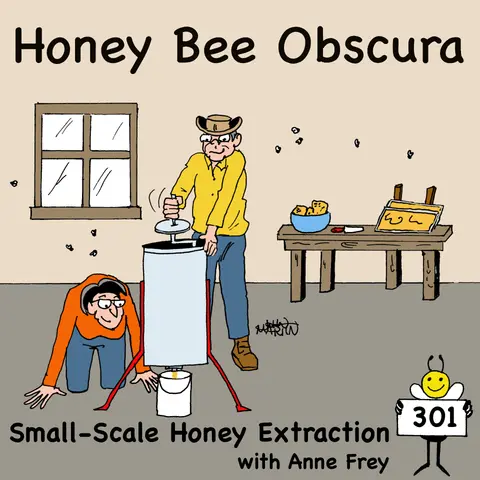
Jim Tew and Anne Frey explore small-scale honey extraction, from borrowing a club extractor and choosing uncapping tools to stabilizing small machines, handling wax, and using crush-and-strain. Their practical advice: fit the equipment to the operation, expect the process to evolve, and keep it clean.

 Apple Podcasts
 YouTube
 Spotify
 Amazon Music
 Overcast
 Castro
 RSS Feed
 Honey extraction can be rewarding, but for a small operation it can also be sticky, awkward, and surprisingly hard on the wrists. In this episode of Honey Bee Obscura, Jim Tew and Anne Frey compare practical ways to get a modest honey crop from the comb without pretending there is one perfect setup, for small-scale honey extraction.
Jim traces his own path from a two-frame extractor to larger equipment at Ohio State and, decades later, back to a small extractor for seven or eight colonies. Anne suggests that beginners first borrow an extractor and other processing equipment from a local beekeeping club, while Jim makes the case for keeping durable stainless-steel tools that may become useful again as an operation changes.
They examine uncapping options ranging from cold and heated knives to uncapping planes, scratchers, and rollers. Anne explains why a pulling motion can be easier on the wrist and what happens to wax fragments after pierced cappings release their honey. The conversation also covers settling and straining honey, saving cappings, and the tradeoffs of crush-and-strain processing.
Small extractors bring another challenge: vibration. Jim and Anne swap inventive approaches involving floor anchors, plywood bases, added weight, wheeled stands, and even a spring-mounted utility trailer. They also discuss running multiple small extractors instead of immediately buying a larger machine.
Their conclusion is simple: match the equipment to the size of the operation, stay open to changing the process, and keep every surface and tool clean.
______________________

Thanks to Betterbee for sponsoring today's episode. Betterbee’s mission is to support every beekeeper with excellent customer service, continued education and quality equipment. From their colorful and informative catalog to their support of beekeeper educational activities, including this podcast series, Betterbee truly is Beekeepers Serving Beekeepers. See for yourself at www.betterbee.com

We’d like to thank Vita Bee Health for supporting the podcast. Vita provides proven tools for controlling Varroa—from Apistan and Apiguard to the new VarroxSan extended-release oxalic acid strips—helping beekeepers keep stronger, healthier colonies.

Thanks to Bee Culture, the Magazine of American Beekeeping, for their support of Honey Bee Obscura. Available in print and digital at www.beeculture.com
______________________
Honey Bee Obscura is brought to you by Growing Planet Media, LLC, the home of Beekeeping Today Podcast.
Music: Heart & Soul by Gyom, All We Know by Midway Music; Christmas Avenue by Immersive Music; original guitar music by Jeffrey Ott
Cartoons by: John Martin (Beezwax Comics)
Copyright © 2026 by Growing Planet Media, LLC


Episode 301 – Small Scale Honey Extraction with Anne Frey
Jim Tew
Hey listeners, it's Jim here again this week. I've got a fairly routine special guest. Even though she's routine, she's still special.
Say hi, Anne.
Anne Frey
Hi, it's Anne Frey with Jim today.
Jim Tew
She's from Betterbee, people who provide bee supplies to the world. Anne and I were talking about this time of the year when we extract honey. What do you do if you're a smaller producer, even a larger one?
What are the options available for uncapping and straining and whatever? It's an old topic, but it's always a messy topic. And I'd like for you and me to discuss it.
Anne Frey
Sounds good. I like this topic.
Jim Tew
Honey Bee Obscura listeners, I'm Jim Tew and I come to you here once a week at Honey Bee Obscura. Today Anne and I will try to talk about something you do with plain talk beekeeping.
Introduction
Welcome to Honey Bee Obscura, brought to you by Growing Planet Media, the producers of the Beekeeping Today podcast. Join Jim Tew, your guide through the complexities, the beauty, the fun and the challenges of managing honey bees. Jim hosts fun and interesting guests who take a deep dive into the intricate world of honey bees. Whether you're a seasoned beekeeper or just getting started, get ready for some plain talk that'll delve into all things honey bees.
Jim Tew
Extracting honey is like me trying to make biscuits. The only place I don't have flour in my house is down on the mailbox down by the road. It's just the biggest mess, and I try not to splash it to make a mess, but I just get flour everywhere. When I try to extract honey, why does it always end up being kind of a—kind of an exciting, sticky, tasty, sweet job. It's just one of those things that's not really beekeeping, but it's certainly an aspect of beekeeping.
Anne Frey
I used to have a friend, he passed away now, he used to say that honey was the most annoying byproduct of beekeeping.
Jim Tew
Oh, I love that. I've never heard that and I love that. I thought that number one would be stings, so occasional stings, but I've come full cycle. I started out with a two-frame extractor and then the years passed and to speed this thing up.
I ended up at Ohio State. We never were big, but we had a 20-frame DC driven 30-frame. And we had sumps and pumps and we had four hundred hives and now the years have passed and I've gotten old and I'm back to seven or eight hives at a two-frame extractor.
So I'm ending up where I started. What are options for people like me? Let's start with the small people like I am now.
Anne Frey
And then if they're really into it, they're quickly trading that in or or putting it in the attic. At that early stage people should just borrow the extractor from their beekeeping club and see how they like beekeeping before they buy a tiny little extractor really. Sorry, Betterbee, we do sell a lot of those small ones, but I just said don't buy 'em. You know, the beekeeping clubs pretty often have a whole extracting setup to loan. And clubs are something that the beginner should always be aware of for every reason.
Jim Tew
Well I agree, but I want to go one step further. On that two-frame you bought and you outgrew it quickly, just put it up in the top of the barn and let it sit there because if you keep bees for fifty-five years, you're gonna get it back down and use it again and it's going to be stainless steel. It's not going to be plastic. It'll be a useful gadget
Anne Frey
There is a plastic extractor. It's the least expensive, weirdest little thing I've ever seen, but it works. It's like for the person who jumps into things really quickly or maybe the student or something like that. Usually it's stainless steel though. It's never gonna go wrong if you put it away and take it out again. Stainless is forever.
Jim Tew
Well, that's exactly what happened to me, and I'm using the extractor now. And happily it's an old AI I know of North Fence to Better Be, but it's an old AI route motorized. two-frame extractor. They were using some kind of sewing machine motor on it to drive the extractor.
Anne Frey
That's the kind of AI I like.
Jim Tew
So that's kind of—kind of an old-fashioned gadget. I always wonder how to go about this. In the earliest days when I was at Maryland, I used a Walter T. Kelley vibrating knife.
It was a contraption with a horizontal knife. They sold them forever. I figured out a way to use a pressure cooker without the safety valve on it, which is going to make a lot of people, including me, cringe.
And I would use that to provide steam heat for the blade. I thought I was just Mr. Modern. Somewhere there's a picture of me with a head full of hair and a skinny guy and no belly running that odd frame across that thing.
And I just thought that that was the epitome of modernness. So I took off the pressure weight off the pressure cooker. I hope I didn't manufacture a bomb.
But I enjoyed those old techniques. And I'm talking too much, but in the earliest days of my beekeeping you could make—there were plans for making an extractor. Now hold your nose using a galvanized garbage can and the drive mechanism off a bicycle to spin a basket that you made out of quarter-inch mesh hardware cloth.
You take off one of the pedals and the bicycle drive mechanism was lying sideways. And then you'd use that to drive the extractor, and then when you'd stop driving it, the clutch would engage and the thing would coast. Now you needed to be a a good machinist. You needed to know what you were doing, but you could make a remarkably efficient extractor using galvanized which is not good.
Anne Frey
I think it could be good, but I'm picturing people just cleaning up a can and getting a pedal set off of some old junkie bike.
Jim Tew
Yeah. Yeah. Use Clorox wipes on that. Well, we're past all that. What about uncapping knives?
Anne Frey
You know, I'm surprised that more people don't know about the plane. I love the uncapping plane, and when I describe it to people it seems like their eyes light up and they go What do you call that again? All they know of is the the long knife, the heated knife or the cold knife, and the plane looks like, uh, a razor, you know, like uh you'd shave your face with. It's just bigger. It's like uh as wide across as a medium frame is tall and it's heated with a self-contained electric element and plug and it's just a better motion. I love the plane.
Jim Tew
You know, I know those exist and I've seen people use them, but in my life, oddly, I've never owned one.
Anne Frey
Yeah, it's a pulling motion and uh I started to get a real pain in my wrist when I was using the knife for days and so uh I just uh I gotta recommend the plane to people. Give it a try
Jim Tew
Let's come back and talk more about knives and planes.
Anne Frey
Sounds good.
Betterbee
Looking to requeen a hive, make a split, or build your own nucs this season? Betterbee has mated queens available.
For shipment or pickup in Greenwich, New York. Choose from Kutik queens, bred for hygienic mite resistance and strong honey production, gentle Carniolan queens, known for managing hive population with the flow, or Betterbee's locally raised Northern Queens, selected for winter hardiness, disease resistance, temperament, and honey production. Order your queens today at betterbee.com.
Vita Bee Health
We'd like to thank Vita Bee Health for supporting this podcast. Vita provides proven tools for controlling Varroa, Apistan, and Apiguard to the new Varroxsan extended-release oxalic acid strips.
Jim Tew
You touched on something and kept right on going that I wanted to go back to. You know most of us envision using that hot knife or nice, white, light combs. But if you get honeycombs with stored honey that's older and been used several seasons and gotten dark, that can really stress you, your wrist, and the knife to hack through that.
Anne Frey
It kind of is the same thing as when people do beekeeping their first year or, you know, two years and then they feel like that's the only way to do beekeeping. You know, you gotta progress and keep learning. You may grow to seven or fourteen hives and still act like it's your first year and you gotta, you know, understand there's more and different ways to do things.
Jim Tew
It's my personality to talk about the negative things. And so the wrist pain and the stickiness and all that. But a good honey crop in the can is really a rewarding thing.
But it really is uh a challenge to get it all done. And in the earliest days, people just used a straight knife and you hacked through it. And then there was a serrated-edge knife that came along.
And then in the old books, yeah, the cold knife. And then they would tell you to take a cold knife and put it in hot water and to rotate that every now and then uh you know, swap out. So when that knife would quickly get cold, when it was especially up against cold honey.
So those older people they really had to work at getting that honey off. We'd like to think that these combs are all nice and new and they come right off. Often you get that nice canary yellow beeswax, but sometimes those combs are not that great and you want the honey out of that
Anne Frey
Yeah, I know some people who year after year are using the cold knife and they just say they love it. But there are other ways to do things. Actually the person that says that is very young and strong.
But you know, you could just scratch at them, you know, you don't get any wax then, but there's rollers, there's steam-heated rollers, there's scratchers Have you seen that steam-heated roller that sits on the on the top of an uncapping tank and you just sort of press your frame straight down into it and up again? It's just gonna pierce all the cappings so they've kind of gone past all these circular blades once down and once up. It's kind of neat. Betterbee has that, but you know, for hobbyists we also have all the smaller versions like just capping scratchers.
You know, that pierces the cappings and the honey will come out. You don't have any cappings later to make candles out of though.
Jim Tew
Well what are you gonna do with all that when it rises to the top? You've gotta let that settle, so you may not get as many cappings, but you've still got
Anne Frey
You'll get some little remnants 'cause some of those torn cappings will tear off uh and come to the top surface of your honey. You're right. Yeah, somebody was asking me all about that the other day and what does she do when she's finished bottling in her bucket and the surface has that fine layer of wax up on it.
What do I do? What do I do? And I said, you know, don't bottle it for giving away or selling in those jars 'cause it's gonna look weird, but I would just eat that honey from that last bottle, the last two bottles that came with that layer of fluffy, fine wax on it.
It's delicious actually. It's a different taste
Jim Tew
I've never thought about doing that. I always skim it off. And do what?
Strain it, and then you get about two tablespoons of wax out of it, and then you put that in your wax bucket and in fifty years you got a whole bucket of wax cappings. That's a long-term plan. You mentioned something a bit ago that flashed me back to an old memory.
I used to give a lot of TV and radio interviews and whatever. Not that I was important. I was just the representative here in Ohio.
And I was interviewed by a reporter from the Cleveland Plain Dealer, and I was explaining all this as though he was an accomplished beekeeper. And I mentioned the fact that these cappings and parts of propolis rise to the top, and I said, it you know, it looks like scum. You just break it off and everything's fine.
Well of course the guy used the word scum, scum, scum throughout the article, and I just cringed every time I read that because I just used that one time to give him a visual analogy so when you're talking to people about bees who are not beekeepers, don't use words like scum and junk honey I used the word junk honey one time And that became the guy's go-to information source for what we were going to be talking about was junk honey and what we did with it. All right, I'm off the subject. All right, Annee, how do you keep those small extractors tied down? They're always like trying to ride a bronco in a small room.
Anne Frey
For years, probably twenty years or more, he had been just shoving it into the corner. You know, so he had it with straight legs not flaring out and he would just push it into a corner and like lean his hip against it while he cranked it. It was on the top the crank.
But that's Other people they tell all their children to sit down along the bottom parts and cling to the legs and things like that. But early on I learned that you gotta put some chains or or uh you know, something that comes straight down from the uh top edge and anchor it to the floor or anchor it to a big piece of plywood and your extractor's on that, you're standing on that, that's a lot of weight. If it still moves around, you could put some weights on it, like buckets of water.
It's just you know, if it's not balanced just right, it's gonna wanna move around and you gotta hold it down somehow. Probably not by asking all your children or bringing in all the pets. You know, there's more modern ways of holding something down.
I almost couldn't believe it until I saw it. Someone in my beekeeping club made a stand that was on three wheels. And it just rolls free.
And so the extractor kind of does this little circular wiggle on the wheels—three wheels—as it's going and everything is fine. It's like you're kind of going with the flow that it wants to do a little wiggle and you're letting it do it, not resisting the wiggle.
It's crazy, but it works.
Jim Tew
So it's not restrained to the wall at all. It can go across the room if it chose to.
Anne Frey
No, it doesn't go across the room. It just does a little kind of a tiny circular dance in place on its wheels.
Jim Tew
Okay, I thought it would over time move.
Anne Frey
Admittedly he only showed me fifteen seconds of video, but
Jim Tew
Well that's fine. I'll take it. It sounds like a good idea if you're able to build such a thing.
Anne Frey
It's uh it's a crazy idea, but it just might work.
Jim Tew
I worked out a system myself that I can't recommend for anybody else because I happen to have the gadget. I've got a small trailer that goes behind my small tractor. And ironically, it has springs on it.
So I would bring that trailer into my shop and then I would ratchet strap my extractor to the trailer. And then the springs would absorb a lot of the vibration as the thing bounced around. Kind of the same idea.
It's basically the same idea. I just happened to have an old trailer that actually had light springs on it. So I could have put four extractors on it, I just had one, so my extracting room was mostly dirty trailer from outside.
Anne Frey
We've started to do that here and it's an idea for not just buying a larger extractor when your operation gets bigger. You can just—like, say you had a four-frame or a six-frame and you got to be too big just to deal with that. Like why not just have another six-frame motorized extractor next to you and you know, essentially you're filling up something with twelve frames and turning it on or maybe they could be offset in time so there's just a constant You know, that one's running while this one stopped and you unloaded it.
It's just these ideas of thinking of a different way to do things. You know, without resorting to bicycle parts, Jim. Right.
Jim Tew
Well ironically I can comfortably say this. There is no standard way. It's one of the ways in beekeeping that a beekeeper can really express
Anne Frey
Oh yeah, you can make comb honey or other people who don't want to invest in an extractor and they don't know about beekeeping clubs, they actually, can you believe it, scrape the comb off of the frame every time they want, honey? And they, you know, of course you know it Crush and strain. I hate when people tell me they do crush and strain.
All that wax the bees made, it's just, you know each year, but they are getting the freshest, most amazing color wax. I hope they make some candles out of it, but I kind of uh just cringe when I hear crush and strain. It's the twenty-first century folks that was capped honey and it was just too much to put into frames and I wanted to minimize what was put into the frames for the colony I kept so I just did the brood comb and some honey.
This would be excess. I would crush it in a colander and just keep mashing it like with a potato masher or something. you know, these are slabs of comb that were cut out of a wall or something like that.
It's not hard to crush it if it's only one year, you know, a few months really old. It's very easy. That's another way to do it.
Jim Tew
And years ago there was a wax press that was sold by the companies and it looked like a fruit press.
Anne Frey
Oh like yeah, like a cider press, yeah. We got one of those too. It's a very shiny modern one. Those are cool.
Jim Tew
I wonder if you could use that to squeeze honey out of comb.
Anne Frey
Oh yeah, yeah, definitely. It's again though, it's kind of a shame. It's uh like a modern version of uh the old cider press kind of thing that a family would have.
Jim Tew
Anne, I'm so sorry, but I have to be the timekeeper here and our time is up. We could keep on going, but basically I've decided that there's no standard way. You do whatever's creative and clever for your individual operation and be prepared to change when something better comes along.
Anne Frey
Definitely keep things clean. Don't say, hey, this is a natural product and let things get all dirty. So uh yeah, I think we've covered a lot of uh points here. If you say we have to stop, we have to
Jim Tew
Say bye, Anne. Bye, Anne. All right, I'm saying bye, listeners. Bye, listeners.
Anne Frey
Bye, Jim.

Beekeeper and Educator
Anne lives in Greenwich, NY and since 2019 has been Betterbee's Head Beekeeper, teacher, and videographer (catch her on Betterbee's YouTube channel!). She first got bees in 1989 while getting a Biology degree, and like most of us, she was a "bee-haver" for just a few years, until she became a member of her local beekeeping club (the Southern Adirondack Beekeepers Association, or SABA), where she learned a lot from members and through club activities.
Anne became invaluable to SABA's operation and led the Annual Seminar and Bee School for many years. Beekeeping associations are so valuable to us because of the speakers and events, but also because of the casual networking, support, and mentoring that comes about when people find a group near them.
She became an EAS Master Beekeeper in 2002 and is still learning to this day. In her limited spare time, she reads sci-fi and rides her bicycle.