Plain Talk: Fishing for Beekeepers (260)
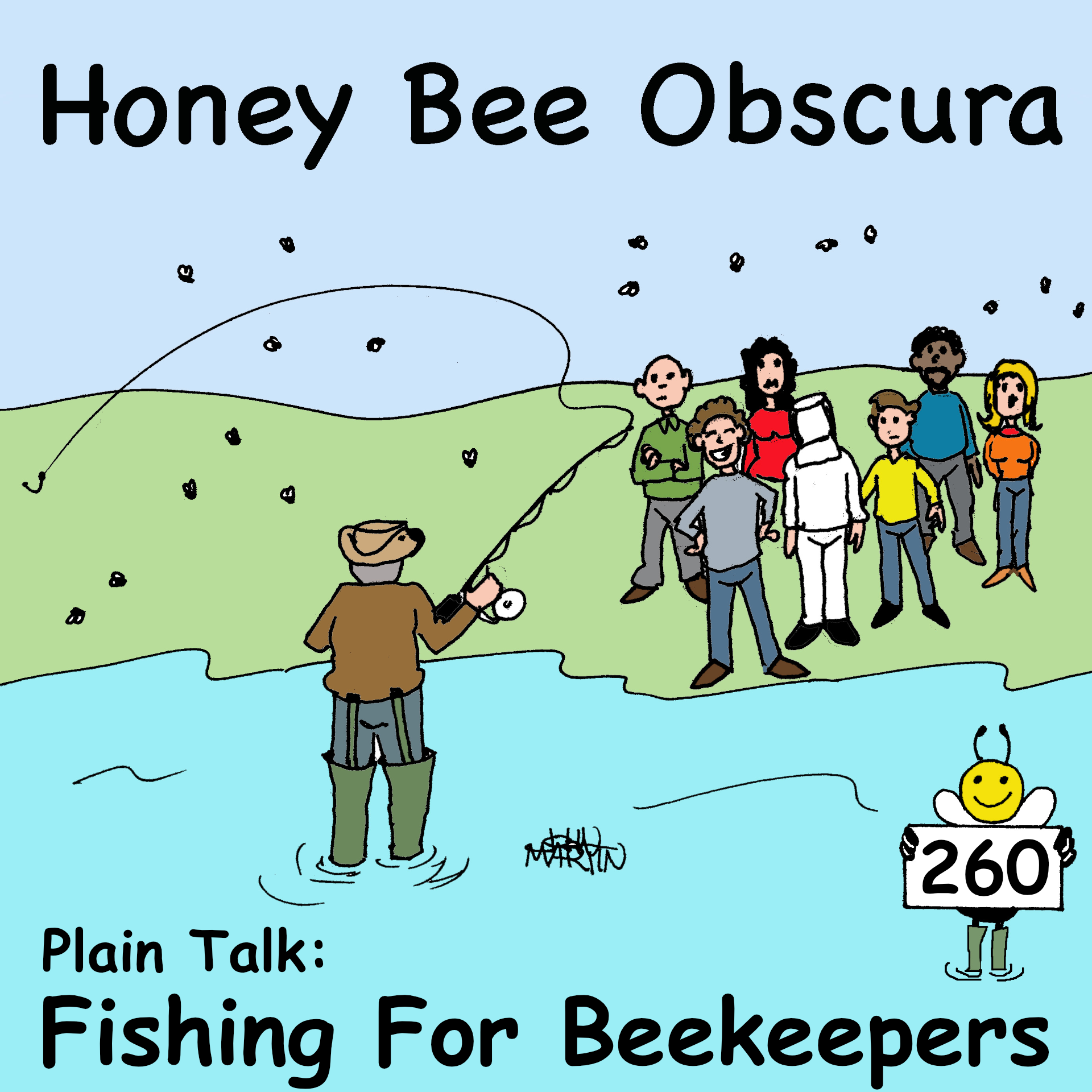
Jim Tew explores the idea of fishing for beekeepers—why some people instantly feel the spark of beekeeping while others don’t. Through personal stories and reflection, he explains how new beekeepers discover their interest and why nurturing curiosity helps keep the craft thriving.

 Apple Podcasts
 YouTube
 Spotify
 Amazon Music
 Overcast
 Castro
 RSS Feed
 This week on Honey Bee Obscura, Jim reflects on a familiar challenge in the beekeeping world: How do we find new beekeepers? A winter snowstorm derailed his plans to record with his grandson and two of his college friends, but the experience sparked a larger, thoughtful conversation about what draws people to bees—and why most people never pick up the craft.
Jim revisits his own journey into beekeeping, remembering how early exposures didn’t quite “stick” until years later, when something finally clicked. This becomes the focus keyphrase fishing for beekeepers: the idea that only a small percentage of people have the spark, and it may take multiple encounters before a future beekeeper recognizes it in themselves.
Through stories about his grandson Will—who clearly has the spark—and Will’s uninterested friends who don’t, Jim explores the unpredictable mix of timing, curiosity, personality, and life circumstances that shape whether someone might take up beekeeping. He also explains why recruiting new beekeepers matters: supporting equipment manufacturers, keeping clubs and associations healthy, sustaining university and regulatory programs, and ensuring beekeeping remains visible and valued.
From observation hives at farmers markets to the ways beekeepers unintentionally evangelize the craft, Jim reminds listeners that encouraging new beekeepers isn’t a requirement—but it’s something that helps preserve a 5,000-year-old tradition for future generations.
Snow or no snow, Jim’s message lands clearly: keep planting seeds. The next beekeeper might just be waiting for the right moment.
______________________

Thanks to Betterbee for sponsoring today's episode. Betterbee’s mission is to support every beekeeper with excellent customer service, continued education and quality equipment. From their colorful and informative catalog to their support of beekeeper educational activities, including this podcast series, Betterbee truly is Beekeepers Serving Beekeepers. See for yourself at www.betterbee.com
______________________
Honey Bee Obscura is brought to you by Growing Planet Media, LLC, the home of Beekeeping Today Podcast.
Music: Heart & Soul by Gyom, All We Know by Midway Music; Christmas Avenue by Immersive Music; original guitar music by Jeffrey Ott
Cartoons by: John Martin (Beezwax Comics)
Copyright © 2025 by Growing Planet Media, LLC

Episode 260 – Plain Talk: Fishing For Beekeepers
Jim Tew: Hey, listeners. It's Jim. Well, I got bad news and then I guess I've got maybe even a little bit more bad news. I'm in Western Michigan, visiting my family here for a recent holiday. I had a real nice time visiting with all my daughters, son-in-laws, grandkids, and all their dogs. While my grandson was here, those of you who've been with me for a while may remember him. My grandson, Will, who's somewhat of a beekeeper, so much as he can be, was going to be here, so I thought, "What a great time for us to go out, visit his hive, and talk about bees, and get this youthful exuberance, not just for bees, but for life."
Then listeners, a storm came through and dropped 10 to 12 inches of snow here. Everything radically changed. Plans were up in the air, and it just didn't work out. I'm still going with the original theme, but my star for this segment, as I speak, is on the road trying to get back to his university where he has final exams next week. It didn't work, but I'll do the best I can to fill in for him. Listeners, I'm Jim Tew, and I come to you once a week here at Honey Bee Obscura, where I always try to talk about something to do with plain talk beekeeping.
[music]
Introduction: Welcome to Honey Bee Obscura, brought to you by Growing Planet Media, the producers of the Beekeeping Today Podcast. Join Jim Tew, your guide through the complexities, the beauty, the fun, and the challenges of managing honey bees. Jim hosts fun and interesting guests who take a deep dive into the intricate world of honey bees. Whether you're a seasoned beekeeper or just getting started, get ready for some plain talk that'll delve into all things honey bees.
Jim: My grandson, Will, has a car. He brought two of his friends home with him. All the parents were in a quandary about putting these young men back on the road for the two-hour drive to where they go to school. There was a lot of discussion and disconsternation. Before I knew it, they were packing and loading and telling me that they were sorry and that possibly we could do this online, but that's just not going to work because when he gets back to that world that he lives in there with his friends in their room, he's got to find a quiet place and all that kind of thing, so I had to see that this was not going to work.
What I wanted to work with him on, with him and with his two friends, I bet you those two friends of his are all about 19 years old who could barely spell honey bee, not that they're dumb, but just that they don't have much interest in beekeeping other than just to know the rudimentary facts of bees and pollination and honey. At this point, his two friends don't have any indication of having any shining for beekeeping.
The reason I was happy to talk with these three fellows is because I recently submitted an article to Bee Culture on, I think I labeled it something like Fishing for Beekeepers. How do we find new people? How do we find people who have an interest in bees?
Way back in the early '70s, this is a long story beyond 20 minutes that I have here, using myself as an example, I took an entomology class, my very first one. Over toward the end of that class, we got to the homopterous insects. Within that order, we discussed honey bees. I made a few notes in my book. I still have the book. Strangely, I treasure those few notes. I just wrote down some of the most basic things, that drones are males and females sting, and the queen produces all the eggs. I underlined a few things.
Then we went right on to the zorapterans and the other insects that followed after we discussed homoptera. Nothing clicked. Nothing snapped. I was Jim Tee then just as much as I am now, but that was just one more exposure to bees that didn't click. In that article, I ask, "How many times does one need to be exposed to honey bees before it sticks, before it stays with us?"
In my case, it was about three to four years later that I was working on yet another degree, still within the field of entomology, that I literally stumbled into a beekeeping class. It would be inappropriate to go into it here, but I basically signed up for beekeeping because I needed to get my schedule cemented as quickly as possible. I signed up for a bee class, and then everything else beyond that is history. I went absolutely stupid for honey bees.
Listeners, I can't tell you what changed in me in that three to four-year period. If I can't even explain that myself to you, then how in the world did we sort around to find out what it takes to find people who could have an interest in beekeeping and don't know it?
Ironically, Will was awarded his driver's license after going through all the folder, all forgetting driver's license, and he drove me to Springfield, Illinois, where we went to a bee meeting. It was about a three-hour drive. It's a discussion for another time on what it's like to ride with a 16-year-old driver at 75 miles an hour down an interstate. It's exciting. You're not bored, and you don't want to make a scene, and you don't want to express concern, but you get it out.
We got there, and I told him, "You just stay in the car and sleep," something he seems to be always able to do. Even though he's an energetic man, he requires a lot of sleep. He said, "No, I'll go in with you." He went in, and he really got into it. I gave my talk. I was tired. I'd had a hectic ride down there. We had a three-hour ride back home.
Listener's, my grandson talked to me the entire time home about bees. I was exhausted. I just wanted to quietly sit and try to get through the trip as he drove me home in the dark, but he was just obsessive over beekeeping. I realized that he has the spark and that it may be useful in the future for him to pursue beekeeping because he had the spark. He had the thing. He had the drive. He had the gift.
What is it? I don't know what it is. Why didn't he start collecting stamps? Why didn't he become a woodworker? Why didn't he start take up bird watching? Why didn't he do ever so many things other than suddenly have this deep interest in bees and nothing would do, but that he get a hive? He does have that hive now. He got two. One died almost immediately. The other is still out there. It's neglected. It's basically on its own. I hope it reverted to the wild state enough to hang on.
I was going to ask Will and his friend because one of his other friends went out there with him and had no spark. He didn't care for this. He didn't enjoy this. He didn't sign up for it. He wasn't really into it. Nothing that my grandson could say would talk his friend into it. Right off the bat, listeners, some people have the spark, but most people don't. In that article, I use the estimation that probably only about 1 person in 1,000 US people have a deep meaningful interest in beekeeping. How do you save 1,000 people to find that one?
I was going to ask this young group, exactly what is it about beekeeping that doesn't really appeal to you? What would it take? Under what conditions could you have an interest in beekeeping? I don't know that I ever had an answer to that. When I talked to my grandson about it, he said it's a question of timing. That they have so much else to do. He's a university freshman. He has a significant person in his life, a girlfriend, and they have a very young, untested relationship. There's that.
He's a musician, so he's teaching himself and is taking lessons in several other types of musical instruments. Then he had this bee interest. Clearly, he had a lot of oars in the water, but one thing he does not have is disposable income. He gets the typical jobs that young people get, working in kitchens and washing dishes and whatever, and he doesn't have significant income to divert toward beekeeping.
I've always known, when I had a university program that required me to go find people to become beekeepers, that this is not easy to do. What's the one thing that everyone knows about bees? That is that they sting. How do you convince someone to take on a project that could actually frequently cause them meaningful, serious pain?
If I were to tell you how many times that I've been told, "Oh, I would keep bees. Yes, I'd do it in a heartbeat, but I have a serious allergy to bee stings. When I get stung, I swell, and it's painful, and it really hurts. There must be something about you and your physiology that makes you different." No, sometimes I swell. Sometimes the stings are painful. It becomes a real difficult sell. It takes a person with just the right kind of personality for everything to work out. While you chew on this, why don't we take a short break and hear from our sponsor?
[music]
Betterbee: If you're heading to the North American Honey Bee Expo this January, be sure to check out Betterbee's exclusive show specials. Pre-order now and pick up your order at the show to save on shipping. Plus, start stocking up for the upcoming season with great deals on products like the Colorado Bee Vac, the Betterbee Packable Pullover, select licensed equipment, and more. Head to betterbee.com to check out all the sales and place your Bee Expo pre-order today. Please note, pre-orders are due by Sunday, December 14th, 2025 at 11.59 PM Eastern Time. Additional conditions apply.
[music]
Jim: Why do we want to find new people? Beekeepers cannot shut up. When I was talking to these young fellows, I kept telling myself, "Stay cool. Stay cool. Don't go crazy here. Don't completely inundate these young men in beekeeping, as I would want to do, but look reasonable, look logical, look sane, and at all times, be polite." I tried to do that.
When the subject changed to a football game or to the snow that was coming down or whatever, I would acknowledge that and I would wait for just the right moment and bring it back to the conversation and ask again, "Maybe in the future when you've got a home and a garden, would you remember this conversation and would you then consider something like keeping bees as a way to augment and fulfill your life?" Of course, they said they would because they had nothing to gain, nothing to lose by saying that.
One of the reasons, and there are several, that we need people to always be coming in is that everyone who becomes a beekeeper doesn't stay one, and the reasons for it are myriad. You know the group. You can see these people. They come in. You love them dearly. They're there. They contribute. They grow exponentially. They start with two hives. They have 10. They have 40. They want more.
They're an officer in the club and you can just want to tell them, "Calm down, calm down, pace yourself or you're going to burn out." Too often through the years, I've seen really good bee people burn out. You can't hold that against them. I don't anyway because they gave it their shot. They probably had a nice time. Their interest moved on to whatever else it moved on to, and then they get rid of their equipment.
The good thing that remains is that those people understand. When there's ordinances or concerns about beekeeping, they know how to vote on various restrictions and concerns about beekeeping. Even though they're no longer on the varsity team in beekeeping, they still maintain a non-intentional connection.
The biggest thing that I think of is that we need to realize how important the equipment manufacturing industry is to us and what do they require, customers. If you want really high-quality woodenware, beehive equipment, and particularly if you want high-quality protective gear, there has to be a market for that stuff. I haven't bought a bee suit in 25 years. Those companies that manufacture beekeeping suits probably wouldn't still be doing that if there's not someone who comes in who needs a brand new beekeeping suit.
There's two things that we need so far. We need new people to replace those people who burn out, and we need new people who need new equipment and new gear to keep this manufacturing industry viable. I was there in the early days, and we don't want to go backwards, listeners. We don't want to go back to cobbling up homemade beekeeping gear, protective gear. I tried building my own equipment. Give it a shot. Get it out of your system. It's not practical to do it.
The last thing that's important is that we need help with regulations to support university extension programs, state regulatory programs. If beekeeper numbers are not appropriate, are not strong enough, are not meaningful, then obviously money would go to the programs that are more populated and meaningful. I harp and harp and harp how important beekeeping is to look so mundane, to look so eccentric.
We're all typical beekeepers, probably a man in his 50s or 60s, eccentric, back by his garden doing this bee thing, this kind of a mystery. I wish it could be more spectacular than that. I wish it could be seen in a different light. We're always looked to be some kind of cottage industry of sorts. Without new meaningful people coming in, we just don't have the justification for maintaining support for that.
It seems to me, and I said in the article, that the best thing we can do is just be visible. I tell you just cannot do anything any more visible than putting out an observation hive at a farmer's market or at a fair booth every autumn. Do something to always be looking for that 1 in 1,000 because nobody can sell beekeeping any better than us.
Even though I commonly hear, "Well, I've always wanted to get involved in beekeeping." That's just weird that there's people out there who don't know, who haven't talked to anyone, who didn't have a relative, who don't have a beekeeper in the family, but they just want to get some bees. That's always so interesting to me that those people are out there who innately want bees without any intro.
Most people need to be reassured that you're not going to be stung to death and that there is some reward in this. If you do it big enough, there can be significant reward in it. If you don't do it big enough, there's other kinds of reward: self-fulfillment, satisfaction, communing with nature. There's all kinds of other reasons. It's very diverse. I've said over and over again that there is no standard beekeeper.
It's like using the word auto to describe all the cars. There's so many different models when you say automobile. There's so many different beekeepers, and yet to the public, beekeepers are somehow a single entity. Inside of beekeeping, we all know that there's different types and styles and degrees of beekeepers and beekeeping. Without it being our primary responsibility, we need to do the best we can to convince neophytes that they can do this, they can grow in it, they can succeed at it, and they too can enter our 5,000-year-old craft.
I was just listening to my granddaughter. She's a freshman in high school, and she's been given the poem Odysseus to read. In that poem, they mentioned to prevent those fellows going by the sirens that they would pack beeswax in their ears. I wanted to jump up and say, "Yes, beeswax, that's important," because it was a primary product aside from honey in the early days, and it would withstand salt water on the open ocean, and so it was used for sealants and for all kinds of other things to include lamps and candles. See, beekeeping is even involved in that poem she was reading.
It's been my experience that old-age wisdom is predominated primarily by knowing when to stay silent. I didn't jump up and go into that. We need to find new people. I was going to explore, with my grandson and with his two friends, how and what would entice them maybe doing an essay in some of their biology classes and use bees as an example to slowly train themselves and to keep planting.
What I've done with my grandson is just plant the seed. I've got to wait for him to mature, to grow, to a point where beekeeping is appropriate for him. I may not be here, but I want him to be the one who takes my dad's smoker and hive tool and takes my smoker and hive tool and cherishes that and then carries this thing on. It's not easy finding new people.
My effort was going to be to take some people, practice with them, to make reference to the article that I've written, to the concerns I've had in the past, and to the fact that I always want to find new people to keep bees and to say that it's not an assignment that we all have, but it comes with the territory. By finding new people, we are ensuring our own prosperity and our own equipment availability and regulatory and teaching and educational support.
Tell your friends, but be rational. Don't come across like someone who's bonkers. Our enthusiasm sometimes makes us look that way. My time is pretty much up. I'm sorry that I couldn't make this work any better, but the snow, 10 to 12 inches, really changed things around. We couldn't even get to the beehive this winter. Spring is on the way. I'll talk to you next week. I always enjoy talking to you. Thank you.
[music]
[00:22:06] [END OF AUDIO]


